



Power mapping for narrative change
by: Lunden Mason
posted on Thursday, October 23, 2025
Although our communities — and public health generally — are facing an onslaught of new and varied challenges, it’s important to remember that we already have many of the tools we need to resist injustice and advance health equity. Power mapping or power analysis — a visual aid developed by community organizers — is one such tool for both building narrative power and advancing policy change that gets us closer to equity. Power mapping can help you channel the strategic wisdom of coalitions and teams to create a more effective strategic communication plan, achieve your policy goals, and address power imbalances to support longer-term social change efforts. It acts as a roadmap for taking big-picture goals and translating them into concrete action steps.
BMSG’s Director of Racial and Health Equity Strategy, Dr. Katherine Schaff has supported many groups in California and beyond in using the tool to build narrative power and develop communication plans, after being trained in this approach by leaders in the organizing field: Strategic Concepts in Organizing and Policy Education (SCOPE LA) and the School of Unity and Liberation (SOUL). I sat down with Kathi to learn more about power mapping for narrative change and how this tool can help public health effectively meet this moment.
Q&A:
Responses have been edited for length and clarity.
Tell me more about power mapping.
Power mapping has long been used by community organizers to create a snapshot of the power dynamics that affect their issue and a plan for shifting those dynamics so those who are most harmed by our systems can have a fair say in the decisions that impact their lives. There’s been a lot of discussion in the last few years about how public health is political, and politics are about power. If we think of power as the ability to achieve a collectively agreed-upon goal, we can see across the country that in many governmental, corporate, or other decisions, people who face some of the poorest health outcomes often are not taken into account in decision-making. Power-mapping helps us understand these dynamics and think about how our narrative and communication strategies can not only help us with specific wins that can improve health and decrease inequities, but also intentionally create ways for those whose voices are often left out of decision-making to build their narrative power for the long haul.
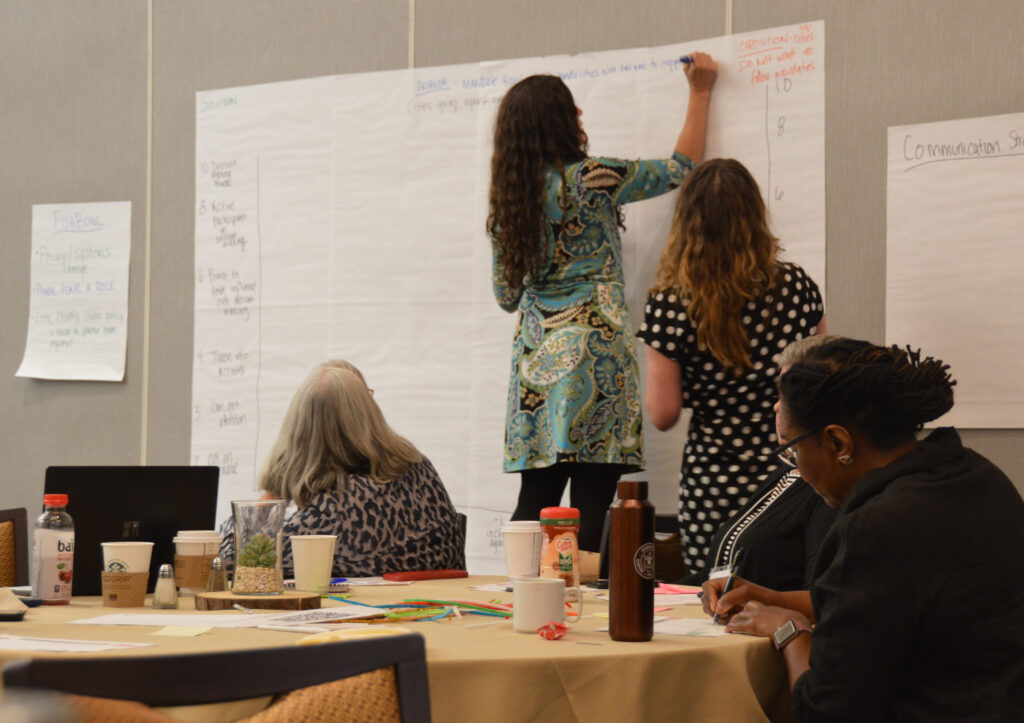
A completed power map can look very busy and maybe even overwhelming, but we always go through it step-by-step on Zoom or in person. We have levels of power on the Y-axis (top to bottom) and levels of support for our issue on the X-axis (left to right). We then collectively discuss and add groups like decision-makers, allies, and those who are not yet engaged in our issue but could be added to the map. This is a great catalyst for discussing how we might want to communicate with them (and communication can go both ways — not only talking to people about our issue, but also listening and genuinely partnering with them) to achieve our goal, what materials we need to develop, who would be effective messengers, what communication support they may need, and how any communication step is also an opportunity for groups to build their power in the decision-making arena.

Why do I need a power map? What is the difference between that and a communication plan?
The tools are complementary. A power map can be a foundation for a communication plan and will help ensure that it is strategic. It can help you identify who has the power to create the change you’re seeking, while a strategic communication plan helps you figure out how to reach the people you identified in your power map with your campaign’s core narratives.
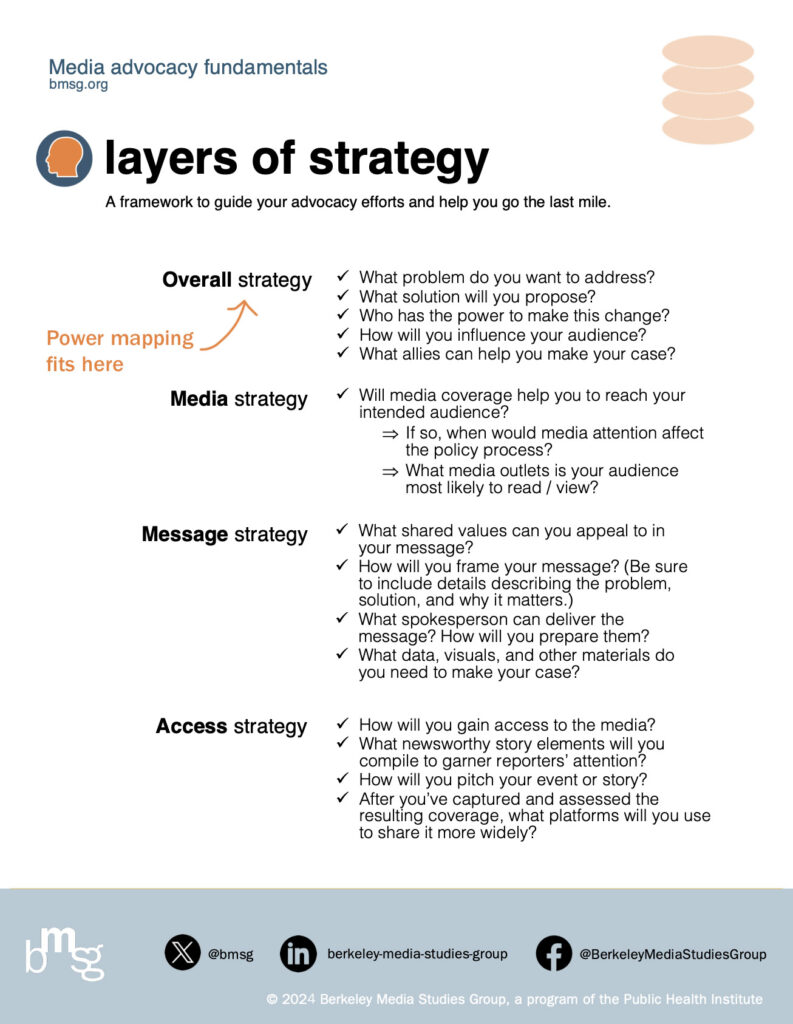
A power map is all about understanding relationships and stakeholders: Who are the people whose support could really move the needle? Who are the people whose opposition to your issue threatens what you want to accomplish? And who are the allies who are currently not taken into account by decision-makers but could be with additional training or support? Once you know the answers to these questions, you’ll be better equipped to craft and then carry out your communication plan. The power map can also be integrated seamlessly into BMSG’s Layers of Strategy, a strategic communication planning tool to help advocates ensure that their media and messaging strategies always reinforce their overall goals.
What might that look like in practice?
Let’s say a group’s strategic goal is to get wavering lawmakers to vote against a harmful housing bill that is about to be passed at the state level and will negatively impact health. You know your main audience is made up of various state lawmakers, like the Senate, Assembly, governor, or even specific committees. A power map can help you determine any other key players you need to reach. What allies could you mobilize and support, or listen to if they are already ahead of you? Who has the power and influence to bend lawmakers’ ears?
Once you’ve mapped the relationships, you can pivot back to your communication plan to decide on specific actions: Does it make the most sense to target the lawmakers with op-eds, and if so, in which districts? With social media posts? With direct action? Through another communication strategy? Once this is decided, it is time to strategize your message and how you’ll deliver it. What’s the right tone —encouraging them to do the right thing or holding their feet to the fire because they are not taking health impacts into account? What talking points will be effective for each audience and platform? What does narrative research suggest about how to frame your issue or what values might resonate? And how can your narrative campaign help those who are most harmed build their power? Perhaps you work at a health department; you might be able to supply community organizers with data on health impacts so they can author a compelling op-ed that gets their names and voices onto the playing field. Again, words do matter, but you can see how they are just one component of a campaign.
This all sounds very structured — aren’t power dynamics sometimes a moving target?
They can be, and that’s why power mapping communication planning is iterative. Think of power maps and communication plans as working documents, not static blueprints. For example, let’s say a legislative visit is the first action a group identifies and takes. Maybe the group learns from the legislator or a legislative aide that the power dynamics are different from what they thought. The legislator may identify another legislator who is movable on an issue — a new target. That’s when it’s time to return to the power map and reassess the communication plan. That might happen multiple times during a campaign.
Can power mapping help my organization more effectively advance narratives about equity and build narrative power? If so, how?
Yes, it can! Here’s how: Power maps help us examine unequal power relationships in our work toward social change. With a power map, you might ask not just about who currently has the power to make certain decisions but also who should have power or a voice in the process. You can use a power map both to understand the current lay of the land and to shift it. For example, if your communication plan includes getting an op-ed published, you can use a power map to identify opportunities to partner with community groups that traditionally have not been taken into consideration in city council meetings. Underrepresentation is a driver of inequities, so uplifting the expertise of community groups can help shift power dynamics in their favor.
OK, so power-mapping is about more than immediate wins.
Exactly. Power mapping makes sure short-term actions are always tied to longer-term goals. In the midst of a specific campaign, folks can get bogged down in the nuts and bolts, and the equity piece can get deprioritized, even if that’s central to the change people are seeking. For example, equity-centric language can get watered down over time when trying to get something implemented, especially when certain policy goals can take years to achieve. With a power map, you’re always thinking about how any means of communicating — writing an op-ed, posting on social media, or something else — builds power to address the root causes of inequities.
Who should be involved in the power mapping conversation?
That depends on how far along you and your organization are in your equity work. If you are just beginning, you may need to step back and start building trust and relationships with the surrounding community before diving into power mapping. Who’s most harmed by the problem you want to address? Are they at the table? Are they taking the lead? Once you’ve reflected on those questions and built relationships with those most impacted, for example, via community organizations, power mapping will provide you with strategies to continue strengthening those relationships while messaging for equitable policies. If, say, you’re an organization that reporters interview, you can agree to an interview only if your community partners are interviewed, too. This approach addresses inequities and helps ensure that your messages feel authentic to your audience, so it’s a win-win.
If my organization does not lobby or participate in legislative advocacy, can we still power map?
Even without the ability to lobby, you can support people in building their power and sharing their stories so that the public and elected officials understand the impacts of policy decisions. Instead of creating a power map about specific legislation, you could make a more general power map that asks: Where are decisions that impact health being made? Are the voices of those who’ve been most harmed or who have the poorest health outcomes being heard? If not, how can you help build their visibility and power? How can you use your organizational power and platform to build genuine partnerships with community members and community groups to ensure their perspectives are at the forefront?
Ultimately, public health is inherently political, and power dynamics exist whether we acknowledge them or not. These dynamics impact our work, and they impact people’s ability to live healthy, fulfilling, long lives — that’s why it’s important for all groups to understand and assess power.
Is there anything else readers should know about power mapping?
Those who are newer to this journey may want to check out SCOPE and SOUL, as they give in-depth trainings on power mapping. We also like this resource from Health in Partnership (formerly Human Impact Partners). People interested in a deeper dive can listen to a recording from the 2025 NACCHO360 conference on how BMSG and the Central California Public Health Consortium were working in California’s Central Valley to support public health practitioners and their community partners in using the tool as a foundation for developing a communication strategy.
I think it’s also important to remind both beginners and seasoned veterans that this work takes time, so be patient with yourself and celebrate every victory no matter how small. They all help bend the arc toward justice.
Interested in working with BMSG on power-mapping for narrative change? Our facilitators can guide your organization through the process. Contact schaff@bmsg.org for more information.