


Narrative work feels hard right now. This new tool on narrating racial justice can help
by: Pamela Mejia and Rachel Weidinger and Heather Gehlert
posted on Thursday, March 05, 2026
Right now it feels both essential and difficult to hold onto a vision for what a socially and racially just country could look like: a country where we all have the resources and freedom we need to live the fullest version of our lives, where every community has a voice in making that vision a reality and the freedom to name harm — safely and without punishment — when it occurs.
That’s why narrative work is foundational to movements for justice. But if you’ve had trouble finding your footing, or your voice, in recent months, you’re not alone.
Millions of people are experiencing a destabilizing mix of grief and uncertainty about the country’s future amid attacks on diversity, equity, and inclusion; deep cuts to programs that keep communities healthy; and ongoing violence at the hands of the state. The harms from these threats do not stop with violations to our rights or physical safety. Fear spreads like a contagion, shaping what we say, whether we speak up at all, and whether we feel safe standing up for our neighbors, or even ourselves.
In times like these, many communicators feel a familiar tension between the urge to say something and the fear of getting it wrong. And questions about how to address critical nuances — like the fact that not all communities experience the same level of risks, and media coverage does not treat all victims the same — can fuel important but lengthy internal debates over the best way forward.
We get it. It’s hard to know what to say today when narrating racial justice. We’re all struggling to communicate effectively in a rapidly shifting narrative landscape, and that struggle isn’t a coincidence: One of the core strategies of authoritarian fascism (strongman leadership backed up by violence) is to overwhelm, and the rise in disinformation and authoritarian rhetoric we are seeing in mainstream spaces only intensifies those feelings.
Still, to protect our democracy and defend core values like racial equity and inclusion, we must raise our voices, even when we feel hesitant.
The tool
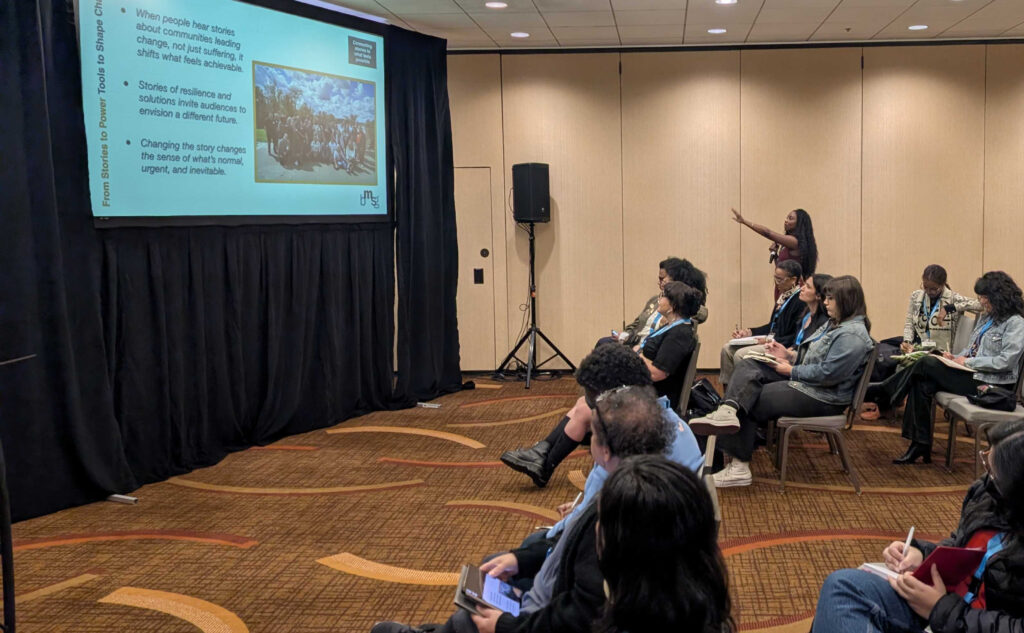
A new decision-making tool from Berkeley Media Studies Group and Narrative Initiative can help you and your partners navigate that uncertainty and overcome decision paralysis. The tool helps guide you through strategic decisions unique to your situation and audiences, so that you can more confidently create messages that center the needs of those most harmed by the current regime, inspire action, and move us toward the future we want to live in. We first launched it for testing at the Just Narratives convening in November 2025, and we’re grateful to the participants in that workshop for helping us revise and improve it.
The tool draws on BMSG and Narrative Initiative’s collective decades of research and practical experience to support your organization’s vital work of narrating racial justice in challenging times. It’s hard, but we can support each other in the work: The tool offers a structured way to think through the tough decisions or challenging questions you may encounter as you write a narrative statement about racial justice. Where possible, we also offer some resources that can help you as you’re considering what to say or how to move forward.
The categories covered in the tool include prompts to help you think through:
- developing your communication strategy (including questions about overall goals, audience, voice and values, etc.);
- navigating internal decision-making, including safety and legal concerns;
- ensuring narrative alignment and mapping power dynamics; and
- identifying and exploring relevant research that can support your work.
Narrating racial justice is very nuanced, especially right now. You may complete the questions and find that you still need to talk with partners, coalition members, etc. about a final decision —- that’s okay! Think of this as a tool to help you consider what still needs to be discussed and what questions remain.
In the face of rising authoritarian fascism, building narrative power matters more than ever. We hope this resource helps you raise your voice — not only to resist, but to continue the fight to build the just future we know is possible.