


Foreword
Agricultural work requires some of the most demanding of all physical labor, and, as such, is often highlighted in the public health literature as an industry with comparatively high rates of work-related injuries and deaths. Research and interventions have typically (and for good reason) focused on encouraging farmers and agricultural workers to invest in safety equipment, use best practices in hazard prevention, and encourage proactive, safety-focused work environments, among other precautions.
However, even when interventions have been proven effective, expanding and implementing them broadly has been difficult and often frustrating for those involved. While encouraging workers and worksites to take a more active role in improving safety is crucial, it may not be as effective when workers don’t have adequate agency to create safer work conditions, and small business owners struggle to invest in better equipment, training, and sufficient staffing for farming operations. These challenges, which many farmers face, inform our mission to support the wellbeing and sustainability of the agricultural workforce, and so we look for ways to improve outcomes by addressing the larger structural issues at play.
This is where media advocacy can help.
The Northeast Center for Occupational Health and Safety in Agriculture, Forestry, and Fishing (NEC) found media advocacy as we were searching for ways to expand the success we’d seen social marketing bring to ROPS, rollover protective structures that can help prevent tractor overturn fatalities. ROPS offer a good example of the importance of addressing structural factors along with changing downstream, individual behaviors.
Tractor rollovers are the leading cause of death on farms annually, and while ROPS’ efficacy has been widely established in the scientific literature, many older tractors still lack these essential devices. Efforts to increase the installation of ROPS on tractors using social marketing approaches have been remarkably successful in encouraging farmers to install ROPS. However, garnering the state or national support to implement this evidence-based solution has proven remarkably challenging, likely because of the need for using public resources rather than relying on individuals to assume all the costs.
Media advocacy presents a promising approach for tackling these upstream barriers to success, as it helps us turn our attention to the social and political context in which policy is decided by influencing the news coverage that informs those decisions. It differs from social marketing, in that media advocacy attempts to amplify an issue to garner broad, public support and pressure decision-makers to enact policy, whereas social marketing aims to change a specific behavior by reducing barriers and increasing motivators for a particular target population. The key difference is that, typically, social marketing’s target audience is the people whose personal behavior needs to change to avoid a health harm; with media advocacy, the target audience is situated within the public policy realm where action needs to be taken, and, if it succeeds, that action will then benefit the population whose health is in danger. Media advocacy has been used to address a number of “wicked problems”1 in the public health arena, with notable success, such as reducing the social acceptability of tobacco use, which paved the way for successful prevention policy.
NEC partnered with Berkeley Media Studies Group on this toolkit to expand our collective ability to bring attention to the proven success of ROPS and other agricultural health and safety interventions so our policy decisions can be more thoroughly informed by the science that guides us to health and safety in every workplace.
Introduction: What is media advocacy?
Defining media advocacy
Media advocacy is the strategic use of mass media to support community organizers and policy advocates who are mobilizing community groups, residents, researchers, educators, and others to pressure decision-makers to enact policies that support health and safety. Media advocates change how public health issues are presented so that decision-makers can recognize the benefits of specific policies and then act to improve health in communities and society at large. Media advocacy is not about overhauling the mass media itself; rather, it is fundamentally about leveraging myriad communication channels to raise voices in a democratic process that uses policy to change systems and conditions.2
Media advocacy differs from other health communication
Media advocacy differs from other health communication in its purpose, target, and theoretical underpinnings. Most health communicators aim to inspire behavior change; they target individuals with messages they hope will motivate them to make healthier choices. These communication strategies operate from exchange theories that assume the health problem derives from a lack of information. In these approaches, the people with the problem are the audience for top-down messages exhorting healthier behavior.
By contrast, media advocacy draws on theories from political science, cognitive linguistics, sociology, and other fields concerned with how public opinion is formed and political behavior is influenced. Grounded in agenda-setting and media-framing theories, media advocacy focuses on the societal context for health outcomes and looks to policy as the mechanism for changing them. Unlike traditional health communication, media advocacy aims to influence policymakers — those with the authority to address systemic factors that either promote health or contribute to injury and disease. Instead of targeting those directly affected by health risks (e.g., workers exposed to hazards), media advocacy targets the policy decision-maker — sometimes a single person or a few committee members. Although the policy action will ultimately protect whole populations, the target for enacting the policy change is narrow.
Media advocacy is sometimes confused with other health communication strategies such as social marketing or public information campaigns because, at the tactical level, they all strive to garner attention — attention from the public, policymakers, and the news. However, media advocacy practitioners typically use mass communication to reach one or two people — members of a legislative committee or a school board, for example — who have the power to make the policy decision that shapes conditions in a given environment. The “mass” exposure is what puts pressure on the decision-makers to hold them accountable. Media advocacy's strategies and tactics keep a sharp focus on supporting community organizing and policy advocacy; media advocacy is not about getting media for media’s sake.
A focus on policy requires attention to news coverage
Safety and health research is important because it describes the social conditions and physical environments that impact agricultural workers’ health. The primary tool we have for influencing social conditions and environments is policy. Policies define the structures and set the rules by which we live and work — on farms and beyond. If agricultural public health researchers are going to improve social conditions and physical environments in lasting and meaningful ways, they must be involved in policy development and vocal in policy debate so their research is brought to bear where it can have the biggest impact. And being successful in policy advocacy means paying attention to the media narratives that structure how we understand our environments.
Skilled policy advocates follow the news because the news media largely determine what issues we collectively think about, how we think about them, and what kinds of solutions are considered viable. Agenda-setting research3,4 has demonstrated that the public and policymakers do not consider issues seriously unless they are visible, and the media play a significant role in bring them to light. Proponents of health and safety cannot afford to be caught unprepared when the events of the day catapult their issues into public discussion.
Media advocacy helps people understand the importance and reach of news coverage, the need to participate actively in shaping the coverage, and the methods for doing so effectively to promote necessary changes for health and safety.
News media set the agenda, and they shape the policy debates that happen once an issue is in the public dialogue. This happens through framing, the process by which people extract meaning from content of all kinds, including words, pictures, or interactions.5,6 Cognitive linguists7 and behavioral economists8 have described how all audiences come to new information they see or hear with preformed ideas about the way the world works, why problems occur, and who is responsible for solving those problems. In an unconscious and automatic process, people weigh new information against well-formed ideas that have been reinforced in their thinking over time. We call these established ways of thinking the default frame.
Understanding the default frame
Understanding the default frame is a fundamental precursor to developing a media advocacy strategy. Rugged individualism — the promise that if you try hard, you can succeed — is a core belief across the United States. We call it the default frame because without other cues, rugged individualism will be the starting point for how most people interpret the causes for and solutions to problems. Across platforms and media, the stories we tell repeat inspiring tales about heroes who pull themselves up by their bootstraps, as the saying goes, and overcome great odds as they achieve the American Dream. Even our computers boot themselves up: They start from nothing and become something. The metaphor runs deep.
At the same time, the individualism frame also evokes the reverse: If you fail, it’s your own fault. The promise of individualism obscures the fact that none of us operates in isolation. We all think, feel, and act in a specific moment that is shaped by our own efforts but also by the conditions that surround us. The promises of individualism — success, independence, self-realization, and autonomy — cast a blinding light that makes those conditions, and the forces that shaped them, hard to see. And when conditions are hard to see, they are harder to name, harder to challenge, and harder to rectify. If solutions to agricultural health and safety hazards extend beyond personal responsibility, then the context surrounding those hazards needs to be visible.9
Rugged individualism emphasizes personal responsibility for solving problems and obscures the social impact, including costs. Public health advocates often have to reframe issues from an individual to an environmental perspective, showing that where people live, work, and play directly affects health regardless of an individual’s personal choices. If individualism is the default starting point, then it will be easy for people to see the farmer as bearing the responsibility for installing ROPS to prevent tractor overturns — it will seem like the “natural” solution.10 At the same time, the default frame of individualism makes it harder to see that as a society, we also bear responsibility and can have a role in protecting the health and safety of those putting food on our tables.
Although people can hold multiple, even contradictory, frames in their heads concurrently, the ones that get triggered and repeated more often have a better chance of influencing people's interpretations. This is where news frames are especially relevant: Besides their direct relevance for policy debates, news stories have enormous reach and influence. The way news stories are framed influences how people interpret the problems — and solutions — they describe. Media advocates work to expand the frame around issues so the context is visible.
Decades of research11 show that news stories tend to focus narrowly on a single person or event. Even when that story is heartwarming or heroic — about someone overcoming great odds, say — it will distract from the conditions surrounding the person. When a story is framed as a portrait, we lose sight of the context or the landscape surrounding that person or event. The research shows that episodic news results in audience interpretations that tend to blame the victim, whereas more thematic news helps audiences understand the impact of environments on personal outcomes.
Similarly, in the field of injury control, many practitioners have taken this a step further and avoid using the word “accident” because that term obscures the conditions that might be at play in an agricultural injury, like being awake for 36 hours, or being 89 years old and working alone, or having to work two jobs so that the family has health care. Terms like “freak accident” or “bad luck” assume prevention is not possible.
Media advocates can elevate the research demonstrating that, in fact, what might seem like a random accident is indeed part of a pattern that can be arrested with the proper prevention measures in place, including policy. Emphasizing how portraits are embedded in landscapes helps make that picture visible and actionable.
Instead of stories about overcoming great odds, we need stories about changing the odds. Stories about changing the odds require us to think beyond portraits of individual behavior to evoke landscapes — narratives that include people, but also the context that surrounds them. A landscape perspective makes visible the social and physical conditions in the environment. By painting a broader picture, we can help people see that neighborhoods, schools, and workplaces influence health. Only then will policies and other changes that improve conditions make sense to people.
Why use this toolkit?
The purpose of this toolkit is to provide occupational health and safety practitioners with a guide for using strategic communication — in particular, media advocacy — to promote healthy public policy and motivate change based on the research that demonstrates what works to save lives, prevent injury, and save dollars.
Media advocacy can help you get news attention for successful research-based solutions to agricultural injury and death, such as ROPS.
Media advocacy moves beyond the limits of changing behavior at the individual level to focus on global changes at the environmental level. The public health literature abounds with examples of behavioral interventions to improve the health and safety of workers, especially in the nation’s most dangerous industries — agriculture, forestry, and fishing. Scientists working in this domain have dedicated expansive efforts to encourage workers in these industries to take fewer risks and embrace workplace safety practices consistently.
While these are worthy efforts and have improved knowledge of risks and safety practices, many have not demonstrated consistent or widespread reductions in illness, injury, or death. Given this, we must ask: Why have we not made more progress in reducing injury, illness, and fatality rates for the nation’s workers? One key reason is that society — and the rules by which it is governed — often need to change as much as the individual. Research funding focused narrowly on traditional injury prevention or practitioners who are shy of — or explicitly banned from — conducting advocacy campaigns exacerbate the situation.
Yet if we know that improving conditions will prevent injury and death, how do we get society to change? Individuals play a role, but we also need to move upstream. Consider seat belts. It took public policy to require that seat belts be included in vehicles. Then campaigns were conducted to inform and educate the public about using seat belts. But communication campaigns that asked people to buckle up had only limited success. Refinements led to a deeper understanding of the problem, linking individual behavior to the broader policy environment. Seat belt use increased dramatically only after primary enforcement laws were in place. The issue moved from policy to personal behavior back to policy.
The National ROPS Rebate Program Initiative provides a similar example. This program seeks to prevent the most frequent cause of death on farms: tractor overturns that occur without ROPS in place. In the early stages of this program, public health practitioners were successful in encouraging farmers to install ROPS when infrastructural changes, like rebates for the installation of rollover bars, offered solutions for addressing their barriers to ROPS installation. However, to implement this solution for farmers everywhere, ROPS needed more investments in infrastructure including rebate funding. Researchers then explored the potential for using media advocacy to create the necessary momentum to inform policymakers about the benefits of investing in this successful program. Without a doubt, ROPS rebates in some U.S. states would not have been possible without media coverage of farm deaths and concerns about increases in tractor overturn deaths.12 (See the Appendices for a description and timeline of the ROPS initiative.)
Despite mass media’s enormous reach and potential as a tool for change, researchers have typically not been in the position to use it to its full advantage. A priority for researchers — indeed, a requirement — is to publish in academic journals. This is crucial for building the body of knowledge society needs to enact solutions to complex public health problems. But for the research to realize its full impact on the health and safety of agricultural workers, researchers and others will have to communicate their findings with a broader audience using language that non-researchers can understand. Structural barriers in research institutions can thwart this process with, for example, prohibitions on communication that mistake advocacy for taking a political side. Indeed, if research institutions get better at using news narratives and support their researchers in media advocacy, they will more effectively reach policymakers, giving them a reason to act and help local communities apply research findings that improve health and safety.
This toolkit is an opportunity to exit the day-to-day world of research to think about how we can apply our findings so they have the biggest impact and improve the health and safety of the workers and communities we serve.
Media advocacy foundations: Use the Layers of Strategy to determine the pathway to policy
So how can we apply our research findings to have a meaningful impact? Impact depends first on knowing what we want to do so we can talk about our goals precisely. For example, we often talk about ensuring safe working conditions for workers, categorizing our goals with the broad label of “agricultural safety.” But what does “agricultural safety” mean in practice? Under what conditions do agricultural workers need to do their jobs in order to stay safe, how do we know when we have achieved safe work environments, and who is responsible for seeing that those environments become safe and stay that way? If the research shows a need for change, what changes are necessary? And whose help (or decision-making power) do we need to improve health and safety for agricultural workers?
In the case of ROPS, safety means having the resources to install rollover protection. The research is clear that ROPS protect people, and public investments are warranted because of the injuries and deaths that will be prevented and the dollars that will be saved. To increase ROPS installations, those who hold the public purse strings need to be reminded of their duty to their constituents (the agricultural workers and their families) and the public whose resources they steward. This approach means our communication efforts must go beyond campaigns for “public awareness,” which typically focus narrowly on encouraging farmers to install the bars on their tractors, without attending to barriers like alleviating the cost burden on farmers. It means we need to use communication strategically to apply pressure for policy decisions that will provide financial support to retrofit older tractors with roll bars, for example, or other evidence-based policies that will improve health and safety for agricultural workers.
When we move from a behavioral problem defined at the individual level to a social problem at the population level, we move from a short-term focus on programs to a longer-term focus on policy change.
That is why the target audience is not the person with the problem (the farmer with a tractor that needs retrofitting) but the policymaker who can provide the resources to make the retrofit happen. Raising awareness about agricultural safety is important since many people may not be aware of how common certain kinds of death and injury are. But what happens once an audience becomes aware of the problem? What should they do with that information? Advocates can develop the answers to these questions by determining their overall strategy, the first element of Berkeley Media Studies Group’s Layers of Strategy, which guides anyone trying to effect social change to create focused communication to reach their desired audience.
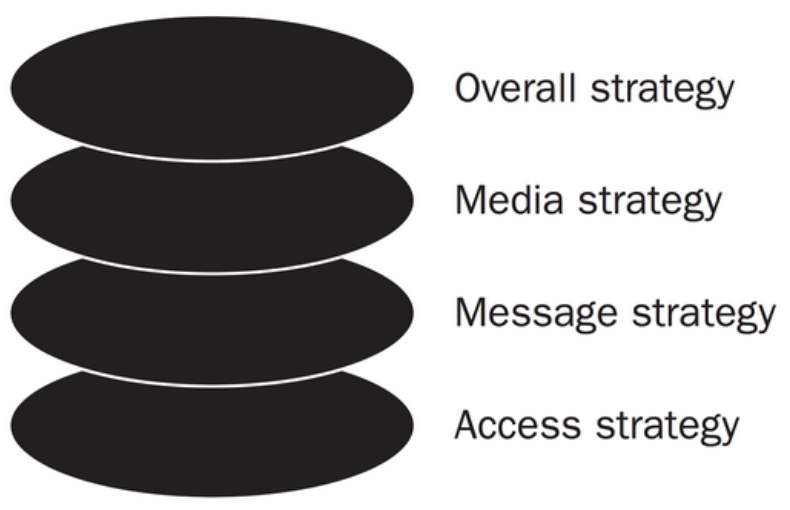
The Layers of Strategy divides the work into four stages: overall strategy, media strategy, message strategy, and access strategy. The overall strategy articulates the goal (usually a policy change), who can make the change happen (the primary target), and who can put pressure on decision-makers. After identifying this first important step, advocates can figure out what channels of communication they will use to reach their target (media strategy) and what language will help the target see why the desired change will improve community health (the message strategy). Finally, the access strategy is about getting attention from journalists or others with the capacity to broadcast the message. Access strategy answers the questions: What steps are needed to get media coverage or placement in another medium of choice (e.g. social media platforms)? What could make this issue newsworthy? What materials (e.g., spokespeople, visuals, social math) would make this story easier for reporters to tell (and how can advocates shape that coverage so that it is impactful)?
Overall strategy: Who is the audience and what do they need to do?
Media advocacy is driven by the overall strategy. Even though the message is important, messages have to grow out of the policy-change goal described in one’s overall strategy. Message should never be the first consideration. Moreover, messages will be stronger if they are anchored in values: the reason policy-change goal matters.
An overall strategy answers these questions:
- What is the problem, and how should it be solved?
- Who has the power to make that change, and what should they do?
- Who can be mobilized to exert pressure on decision-makers and advocate for the cause? What’s the next step they can take to be part of the solution?
Since media advocacy is focused on the policy changes needed to create environments in which people can be healthy — and not behavior change — the target is not the person with the problem. Nor is the target the “general public,” which is not specific enough to be a target audience, even if the objective is to get media attention.
Rather than simply raising awareness among the general public, media advocacy is about sparking action among particular powerholders.
Media advocacy’s target audience is the small but powerful group that holds the policy levers that need to be pulled.
In other words, media advocacy treats people in the community as citizens with a say in how their environment is structured, rather than as passive consumers of information and instruction. The shift from building awareness to using media advocacy means using communication not to change health habits, but to influence policy. For ROPS, it will mean that in addition to letting farmers know about the lifesaving capacity of these structures, we must also elevate the issue in public discourse, often via news media, so policymakers are attending to the issue and feel the pressure to add the necessary supports. The question for your overall strategy is: What is the request that should be put before policymakers? The target audience (e.g., House and Senate Agriculture Committees, Farm Bureau, USDA Officials, State Departments of Agriculture, etc.) will depend upon your particular policy goal.
Framing ROPs*
| Tobacco (for comparison) | Farmworker safety | |
|---|---|---|
| Problem | Corporate behavior promotes an addictive deadly product that kills when used as directed. | Installing rollover bars is often too expensive for farmers to pay for without help. |
| Responsibility | Belongs to the tobacco industry and those who regulate it. | Belongs to the government officials in charge of agricultural policy. |
| Solution | Policies on availability and youth access (e.g., raising the minimum age to 21), excise taxes, secondhand smoke, eliminating flavors, eliminating target marketing, and phasing out products. | Leveraging agricultural policy to allocate funding needed to offset the cost of rollover bar installations for farmers |
| Values | Protect youth, promote health, and hold industry accountable. | Invest in the people who provide our nation's food; protect our essential workers. |
| Story elements | A graph that compares the number of tobacco retailers (375,000) in the U.S. with the number of McDonalds (14,339) or Starbucks stores (11,962) is good social math and a compelling visual. (Truth initiative 2017) | Images of the steep inclines and dangerous conditions of many farms; a bar graph showing the dollar value of the food produced by U.S. farmers vs. the cost of ROPs rebates. |
*using tobacco example to show how to use this table
Once you have determined the policy goal and the person or people in the position of power to establish or adapt the policy, the next step of the overall strategy is to invite the allies who can join the effort and help make the case. After all, the more people who are putting pressure on the target, the more likely they are to make the preferred decision. Bringing news attention to the issue provides some of that power, even if most news consumers don’t act on it, because the target — the policymaker — will know everyone is in on the conversation.
If you find yourself undecided about how to begin crafting an overall strategy, consult the Haddon Matrix, a framework for thinking through injury and safety from the perspective of individuals and society-wide interventions and policies.
Media strategy: When to use social marketing, media advocacy, or other communication strategies?
Next in the Layers of Strategy is media strategy, which defines how — or whether — mass media, social media, personal communication, or some combination is best to further one’s overall strategy. In media advocacy, the media (in all its shapes and sizes) is merely a tool for bringing attention to the need for policy change and putting pressure on decision-makers rather than an end unto itself; thus, advocates must determine if, how, and when the media will advance their policy-change goals.
For example, if advocates can influence the target in other ways, such as through in-person meetings or direct pressure from constituents, there may not be a need to engage the news media. If personal meetings with policymakers are enough to spark the sought-after change, media attention can be an effective way to highlight the turn toward health and safety and congratulate the policymaker.
When policy is not the goal, then social marketing may be a better guide for when and how to use media than media advocacy (for more information on social marketing, see “Social Marketing: A Practical Resource for Social Change Professionals”).
If the overall strategy points to policy, then the media can be an effective vehicle for getting the issue on decision-makers' agendas. To develop a solid media strategy, think through which modes of communication and which news outlets at which strategic times will be most effective. Do the targets get their information from the local newspaper? Do they pay attention to online and social media sources? Do they listen to the radio or certain podcasters? In today's information environment, it is likely a combination of all of these.
In recent years, the news has covered agricultural health and safety issues in ways that supported the kinds of systems change advocates are seeking. For example, a series published in the Minnesota Star Tribune about an increase in tractor overturn deaths in the region led to the state of Minnesota reaching out to the NY ROPS Rebate Program to see if Minnesota farmers could take advantage of the program.13 This interest led to the state legislature appointing funds to cover ROPS rebates for farmers in their state.
However, it can take a lot of work to get news attention, which is why advocates need to be strategic about when, how, and why to pursue reporters’ attention. (That is in part why the Layers of Strategy are a hierarchy: The overall strategy will guide when, how, and why to get news or other media attention.) The section on access strategy delves into various techniques for garnering news coverage.
Message strategy: What should advocates say, who should say it, and to whom?
Whether advocates decide to seek media attention for or pursue other channels of communication with the target (e.g., individual meetings or using agency platforms, like websites and social media channels, often called “owned” media channels), they will need a message strategy to make a compelling case to their target audience. The message strategy includes the message, the messenger, and the audience: what needs to be said, who will say it, and to whom (as identified in the overall strategy). These three components are a package because one cannot figure out what the message should be without first knowing who the target audience is and what action they should take. That’s why overall strategy comes first. With those questions answered, it is much easier to see who the messenger should be and what they should say.
Messages generally answer the same questions asked to determine the overall strategy:
- What is the problem?
- What is the solution?
- Why does it matter?
- Who has the power to make the change?
The message strategy asks advocates to think about how the message is currently framed versus how it needs it to be framed to make an effective case. That means accounting for the default frame with which the audience will receive any message. (In the United States, that frame will likely entail something about personal responsibility or rugged individualism since those are dominant frames in our country’s culture, but other frames could appear as well.) It also means arriving at the frame advocates want their audience to hold after a message has been shared with them. As we noted in the introduction, this will likely help your audience move from a story framed as a portrait around a single individual or event to a landscape that reveals the context for the problem and solution. Framing from a portrait perspective means looking at a problem and only being able to see the factors that are within an individual’s control. The problem with placing portrait frames around complex public health issues — like agricultural health and safety — is that the solutions to most problems are outside an individual’s control. Even if individuals do all they can to be safe, if their environment is dangerous, they still might get injured.
Conversely, if problems are framed from a landscape perspective, they show the individual within the broader context of their lives, which includes the systems and structures that have a direct impact on whether they can get and maintain what they need to live healthy, thriving lives. Agricultural workers still need to attend to their behavior and be safe, but those who control the environment in which they work also have responsibility. Pulling the frame out to a landscape perspective — which includes expressing shared values as the rationale for the change being sought — can influence how the target understands the problem and whether they recognize the solution as legitimate.
Having a thoughtful, strategically planned message will ensure that advocates are placing the focus on their values and, most importantly, their proposed solution, which helps spokespeople provide the kinds of details reporters will need when telling stories from a public health perspective. For example, a story about a child with lead poisoning may be dramatic and compelling but will do little to inspire action about lead abatement in older housing if there is no specific solution or policy goal illuminated in the story. In fact, the story may do more harm than good if it places the blame on parents who don’t have the same control over the condition of the housing as their landlords do. When news stories include a solution, not only are readers reminded that we can solve hard problems, but decision-makers can be held accountable as the public forum of news media makes the connection to their role and responsibility.
Now that we’ve identified the components of an effective message and message strategy, let’s see how they look in a sample message:
Sample message
Adding rollover bars to tractors has been a simple yet highly effective method of preventing farmer injury and death. But the cost of adding those rollbars and seatbelts can be prohibitive for farmers — often costing somewhere in the range of $2,000. As an investment in the people providing food to the community, the National ROPS Rebate Program offers rebates to farmers who install the rollover bars to their tractors. While farmers in several states are eligible for rebates through the National ROPS Rebate Program, the program still has not been fully implemented in Missouri, meaning many farmers are still at risk for injury or death. The Missouri Legislature needs to take decisive action to implement the program statewide and ensure that all Missouri farmers are protected from these preventable tragic accidents.14
Legend:
Solution
Problem
Values
The message highlights the key components of a message: problem, values, solution, and target. You may also notice that this message mentions two values right from the start: investment in people and providing food to the community. By leading with values, this message has a greater chance of connecting with the audience and helping them see the importance of solving the problem. This message happens to start with the solution: “Adding rollover bars to tractors has been a simple yet highly effective method of preventing farmer injury and death.” This is a reminder that the order of a message doesn’t matter, as long as each component is included, and that the solution should be emphasized (as it is in the example), so the reader knows what needs to be done and who should do it.
BMSG’s Message Development worksheet can help you craft the components of your message strategy.
Access strategy: How will advocates deliver their message?
Access strategy answers the questions: How will advocates get news coverage or placement in another medium (e.g. social media platforms)? What could make this issue newsworthy? What can advocates provide to a reporter to make this story easier to tell (e.g., story elements like spokespeople, visuals, or social math)? And how can advocates shape that coverage so that it merits news coverage at the same time it clearly conveys their message?
Access strategy is about gaining access to journalists, bloggers, podcasters, and other content creators who can reach the audience (i.e., people in positions of power to create change) identified in one’s overall strategy. Access strategy determines when and how to seek media attention and prepare spokespersons to deliver the message. An effective access strategy considers when media attention can have an impact on the policy process, perhaps leading up to a vote or budget deliberation, for example, and emphasizes what about the issue is newsworthy. The parts of the story emphasized to pique a journalist’s interest can be different than the parts of the story emphasized after one has gotten their attention. With lots of pressure on their time and an abundance of stories that could be told, reporters and other content creators need key story elements that make this story easier to tell and more interesting than other story options.
A strong access strategy will include factors that make agricultural news and new research interesting and engaging to target audiences. Factors like newsworthiness, visuals, and social math are all aspects of a story that can illustrate what is compelling about it and have an impact on whether a reporter or other newsmaker will pick up the story. Below, we describe each of these story elements in greater detail. But, before reviewing them, remember: Policy change takes time; inevitably, advocates will need to revise and redirect even the most thorough media advocacy plan as circumstances change (and as they learn from what they’ve done so far). The most historic and far-reaching public health interventions — such as ensuring clean indoor air and clean water sources — have been and remain long-term policy battles, and stories about them change as campaigns progress. By working through the Layers of Strategy, and revisiting one’s goals and objectives, advocates can track their progress and reroute themselves when needed.
Authentic voices
Authentic voices are spokespeople who can provide a genuine, firsthand perspective on the problem and the need for a solution based on their personal or professional life experience. They might be a victim or survivor who has suffered from the problem directly, such as someone who has been or has had a loved one injured in a tractor rollover. Or they might have other direct experience with the issue, e.g., as agricultural researchers, local merchants, health care providers, or community members. Media advocates think carefully about the range of authentic voices they can prepare to make their case because, as the saying goes, “the messenger is the message.” News professionals and decision-makers will respond to who is speaking, not just to what they say.
For example, researchers presenting information on the effects of tobacco marketing on children's health may be received differently than would young people who have quit smoking who make the same argument. Once advocates have engaged and trained the right spokespeople, they can make their case in a variety of settings from community meetings and policy hearings to news events. People directly affected by the problem can become effective spokespeople by linking their experience to the need for a population-wide policy solution.
For example, Newtown, Connecticut, emergency room physician Dr. William Begg told a Senate panel on gun violence, “People say that the overall number of assault weapon deaths is small. Please don't tell that to the people of Tucson or Aurora or Columbine or Virginia Tech, and don't tell that to the people in Newtown. This is a tipping point, and this is a public health issue.”15
Not every spokesperson has to say exactly the same thing, but they have to mean the same thing. Campaigns will rely on different authentic voices depending on the setting, audience, or immediate goal. Ultimately, authentic voices will exemplify the core values of the campaign, as when a ROPS hotline coordinator who is also a local farmer speaks directly about what a ROPS rebate program would mean in her community.
Newsworthiness
With the sea of news surrounding us day in and day out, stories not only need to stand out to reporters, but they need to show their relevance to reporters’ audiences if they are to rise above the overwhelming din of information. This is where newsworthiness comes in. When stories are relevant — because readers can connect to them — reporters will be more likely to cover them, and more people will read or listen or watch. BMSG has identified several elements of newsworthiness that media advocates can use to make their stories enticing to journalists and relevant to audiences. The questions in the table below are designed to spark advocates’ thinking about how to make their story newsworthy.
| Element of newsworthiness | Key questions | Example |
|---|---|---|
| New data or research | Does the story describe novel data or statistics that are important for understanding the issue and what to do about it? Can the data be reported in a way that emphasizes implications for policy solutions and preventing future incidents? Are there national data that can be disaggregated and made local? Has funded recently been awarded for a study? Is this the anniversary of significant findings in the field? | Example: The release of local farm injury statistics creates opportunities to discuss the benefits of investing in prevention. It is an opportunity to highlight the collective action underway to address the problem. |
| Controversy | Does the story describe conflict or controversy that advocates can highlight? What is at stake? For whom? Should a business, institution, or government agency be doing something differently? Are rules or regulations being violated? Who is benefiting from this problem not being solved? Who is losing out? How? | Example: Controversy is a key news value that is sometimes at odds in a rural setting where personal relationships are close and frequent. Organizations will need to decide whether this tenet of newsworthiness will help them or not, even though reporters will always be interested in highlighting controversy. In the case of ROPS, for example, a controversy might be a report that names the legislators who are ignoring the impact the policy would have on the local budget or that legislators have ignored the pleas of grieving families. |
| Irony | What is surprising about this story? Is there a contradiction to point out between how things should work and how they are really happening? Is there hypocrisy to reveal? | Example: The irony in public health overall is that we have solutions to vexing problems that are simply being ignored. If there is a comparison to be made, use it. Perhaps the biggest irony is that we already have the solutions, but they are not being put in place. Rather, decision-makers keep talking about the need to keep farmers safe but aren't taking the simplest action to do so. |
| Injustice | What is inequitable or unfair about: -the story being pitched? -about the decision of an institution, business, or government agency? -about the treatment of a community or vulnerable group? Is this injustice serious enough for the media to adopt an ongoing watchdog role? | Example: Use the pride of place and community connection that people share to call out the injustice of not putting prevention in place when we know we can and we know it works. Explain that as people who care for one another, we have an obligation to institute what we know will save lives. |
| Anniversary | Can your story be connected to the anniversary of a local, national, or historical milestone — like a tragic incident that brought the community together, or the beginning of a safety initiative? Was legislation passed or regulation approved that has made communities safer? Does the anniversary offer the opportunity to ask what happened then and where we are now? What progress has been, or should have been, made? | Example: On the anniversary of an unnecessary death or injury, remind policymakers that they are in the position of preventing such tragedies in the future. Or, on the anniversary of a budget expenditure that did some good, note that it’s time to do that for agricultural policy, too. |
| Broad population interest | How does the story affect a lot of people even if it is related to a specific group, like children, struggling workers, or the unemployed? How can your story emphasize the aspects of agricultural safety and prevention that are important, interesting, or appealing to the broadest number of viewers or readers possible? | Example: Advocates making the case for community safety initiatives highlight how members of the public — even those not directly impacted by agricultural policy — benefit when others are served by safety measures. With the right measures in place, it means their neighbors are going to be healthier and, as a result, the whole community will be healthier. |
| Local interest | What about your story is important or meaningful to the local audience that reads a specific publication or watches a specific channel? Is there an event related to community safety (like a talk, county fair, ribbon-cutting ceremony, etc.) that readers or viewers should know about? If not, can you create a local event? Note of caution: Planning events takes a lot of work. If you are doing an event exclusively for media attention, work ahead of time to be sure that your event will get covered. | Example: Reporters will want to talk with and feature local community members who have direct experience with agricultural safety programs. Local educational events or community gatherings where the program will be discussed can be an occasion for a news story, especially when they emphasize solutions and collective action. |
| Seasonal or holiday link | What about your story, issue, or policy goal can be connected to a holiday or seasonal event? Are there seasonal celebrations with community roots that can be connected to agricultural health and safety? | Example: As Christmas approaches, should local legislators be putting ROPS programs under the tree? On Mother’s Day, should farmers’ wives rest assured their husbands and kids are operating equipment made safer by ROPS? Link to seasons or holidays to call for policies that would lead to safer communities. |
| Breakthrough or milestone | Does the story describe breaking news relating to agriculture health or safety? Does the story mark an important medical, political, or historical first? Can you make the case that, given a particular event, decision, or action, things will never be the same with respect to safety in your community? | Example: Can you celebrate a success in implementing safety programs to remind people that policy change works to protect communities? |
| Personal angle | Is there a person who can serve as a representative example of the broader problem — for example, someone with direct experience who can provide an authentic voice? Is that person prepared to talk to a reporter about agricultural health and safety in a way that emphasizes the necessary policy solutions and illustrates that prevention is possible? | Example: Any local family member who is willing to share their personal story of loss and advocates for greater funding for ROPS programs will be the center of a compelling story. People who have lost loved ones in these circumstances are powerful and effective authentic voices for systemic changes that would prevent other families from experiencing their loss. |
Visuals
Visuals may be part of making a story newsworthy, or may be powerful enough on their own to be the story. Regardless of the platform, media stories rely on images in our increasingly visual culture. When you are pitching an event or story, reporters will often ask, “What will I see when I get there?” What they are really asking is, “What will I show my viewers or readers if I do this story?” Make sure you have something visual to offer. Good visuals can capture a reporter’s attention and convince an editor to give the story a more prominent position in the news lineup or placement to reach more eyeballs. Both will help advocates reach their targeted decision-makers. Developing the right visuals for a story is a strategic decision, as well as a creative endeavor. Advocates should brainstorm all the visual options they can and then choose which best illustrates their frame. Pick visuals that don’t just get an issue in the news, but get attention for the proposed policy goal.
Look at an event through the eyes of a camera.
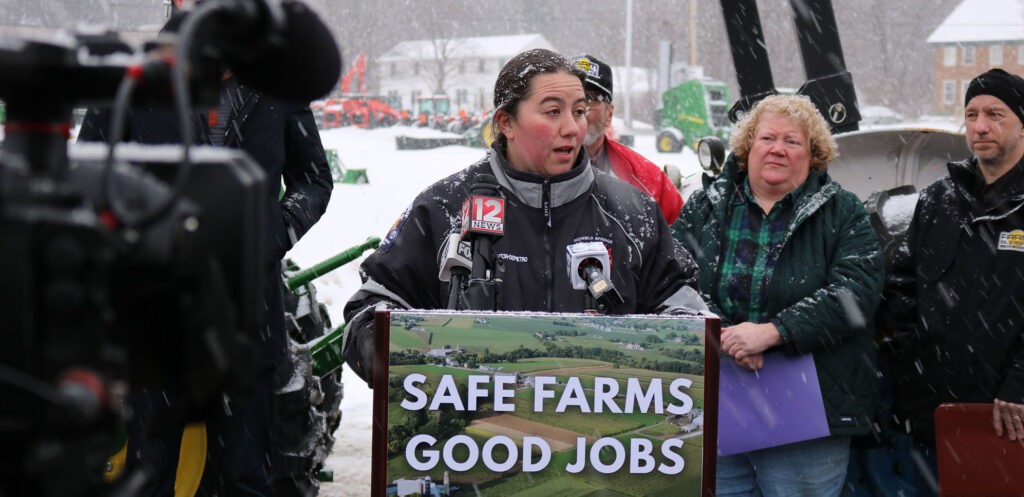
If advocates are bringing people together for an event, use items such as T-shirts, hats, or signs to unite them visually as a group. Packing a legislative hearing room with supporters, for example, is more powerful if the legislators or press can see, at a glance, that everyone there is supporting the proposed bill. And depending on the hearing room, “packing” it might mean just 10 to 20 people. At press events, make sure there is a banner or podium sign positioned so that it is part of any picture taken of the spokespeople. The banner should include appropriate logos and, if there is room, the part of the message that says why this matters.
Make sure the visual tells the right story.
Every story has many potential pictures. Make sure to pick one that reinforces the desired frame and policy goal. To garner a story about the importance of rollover bars, show the steep or uneven surfaces on farmland that could lead to tractor rollovers or the comparative size of the average tractor to a driver, and what we can expect should a tractor tip over. In selecting visuals, ask: “Will the reporter, and eventually the reader or viewer, connect this picture to the policy issue at stake?”
Show the solution.
Help the target see that the solution being proposed is achievable. Share a video of how simple it is to install rollover bars on a tractor — and make the case that farmers just need the resources to purchase them. Even if a success story happened in another city or state, it can still help explain the vision.16
Advertise assets.
After creating compelling visuals, let reporters and editors know. When pitching the story, tell them what they will be able to record at the event. Include this list in the media advisory and press kit.
Social math
Social math is anything that makes numbers more meaningful and accessible by placing them within a social context. Advocates can create social math by breaking down numbers by place or time; by making comparisons with familiar things; or by personalizing them. Take this statistic, for example: More than 8 million people die each year from tobacco use or exposure to secondhand smoke. That sounds like a lot, but it’s a big enough number that it is a little hard to comprehend and may not be memorable. Readers could walk away and not give the statistic a second thought. But if we use social math and recast it to say, “Globally, over 22,000 people die from tobacco use or second-hand smoke exposure every day — one person every 4 seconds,” as the World Health Organization has done, it’s much easier to grasp the scope of the problem.17
Social math can help audiences view issues in a tangible way, rather than merely in the abstract. Social math also challenges people to rethink what they know — or thought they knew — about an issue. Many legislators may not know the risk of tractor rollovers or other agricultural health and safety issues or the injuries and fatalities they cause. Advocates can show the scale of the problem in their area by comparing it to other known numbers.
Conclusion
A familiar goal for public health communication is “increasing awareness,” with the idea being that more information brings better outcomes. That explains why many interventions in public health focus on the individual, targeting the person with the problem, asking them to change their behavior (think about smoking-cessation programs, healthy-eating programs, or campaigns like “Don’t drink and drive.”) Even when these programs encourage healthy decision-making, they help only one person at a time — eventually, the next person will come along, so the information campaign can never end, thus extending the time it takes to widely adopt and implement public health solutions. Rather than reaching individuals one at a time, we need strategies like media advocacy that change workplace conditions so that no matter who enters the work environment, they will be protected — whether or not they’ve been exposed to a health information campaign. When it comes to agricultural injuries like tractor rollovers, one fatality is one too many: We want to make a bigger impact and shift the conditions under which agricultural work is done so that no matter who sits on a tractor, they will be protected because it will have ROPS.
Media advocacy can expand the conversation about agricultural health and safety to bring in elected officials, others in government, community leaders, corporate decision-makers, and the public at large. We’ve seen this happen with other public health issues like alcohol, tobacco, and vehicle safety, which has taught us that researchers, public health professionals, and advocates can build well-traveled bridges among themselves and collaborate on strategies to enact policies to improve health and safety. Agricultural health and safety researchers will strengthen this conversation, and muster support for prevention policy, when they use media advocacy to move the problem definition upstream and articulate the shared responsibility for ensuring agricultural workplaces are as safe as the research shows they can be.
All too often, effective public health programs are developed and then placed delicately on a shelf with few resources or protocols to widely implement them.
The field of Dissemination and Implementation (D&I) Science18 developed out of a need to accelerate and expand the reach of these programs, thus improving the lives of citizens. Unfortunately, even with the expansion of this work, the D&I community continues to acknowledge and struggle with the well-known statistic19 indicating that an average of 17 years is needed to widely adopt and implement successful health programs. This toolkit aims to reduce that timeline. By using media advocacy, agricultural health and safety researchers can amplify their voices, accelerate the adoption of farm safety policies based on their research, and begin closing this research-to-practice gap. When our field is communicating loudly and consistently about the big picture of agriculture research, policymakers and the public will see how it guides us to safer, healthier futures for farmers and their families, their employees, and the broader community. If applied at scale, when we give voice to why we do the work in the first place and how all our communities — within and beyond agriculture — benefit when research is supported and applied, we will save lives and dollars.
Acknowledgments
The authors would like to express sincere gratitude to our partners at the University of Nebraska Medical Center (Aaron Yoder), University of Missouri (Karen Funkenbusch and Willard Downes), Kansas State University (Tawnie Larson and Ed Brokesh), and University of Iowa (Brandi Janssen and Jackie Curnick) for their contributions to the field of agricultural research and safety, without whose dedication this work would not have such significance.
We extend special thanks also to all of those at Berkeley Media Studies Group (Shaddai Martinez Cuestas, Pamela Mejia, Rosaura Wadsworth, Sarah Perez-Sans, and Kim Garcia) for their willingness to explore ways to apply media advocacy to further advance the field of agricultural safety.
We also want to acknowledge the valuable feedback provided by KC Elliott, John Gibbons, Jennifer Lincoln, Heather Gehlert, and Saneeha Mirza, which greatly improved this work.
Sincerely,
Andrew Johnson, Northeast Center for Occupational Health and Safety: Agriculture, Forestry, Fishing
Pamela Milkovich, Northeast Center for Occupational Health and Safety: Agriculture, Forestry, Fishing
Julie Sorenson, Northeast Center for Occupational Health and Safety: Agriculture, Forestry, Fishing
Lori Dorfman, Berkeley Media Studies Group
Ingrid Daffner Krasnow, Berkeley Media Studies Group
Appendices
Worksheets
- Strategic media advocacy planning questions
- Selecting a media outlet
- Sample media matrix
- Media advocacy calendar
Historical context: Timeline on ROPS research and how we got here today
Decades of research went into developing a social marketing program to prevent tractor overturn injuries. The social marketing program was designed to remove many of the barriers farmers experienced when retrofitting tractors by providing financial and logistical assistance and promoting the reasons for retrofitting that farmers found most salient. Over the years, the program expanded to several states, then nationally. Some states offered ROPS rebates, farmers installed ROPS, and farmers, equipment dealers, and industry advocates gave the program high marks. Cost assessments showed that the program not only saved lives, it also saved money. Unfortunately, efforts to expand national funding for ROPS rebates and sustainability for an effective and popular farm program have not served everyone who needs rollover protection.
| Year | Research/outreach efforts | Rebate funding (ROPS installed as of August 2025)* | ||
|---|---|---|---|---|
| 2006 | 2006-2011: Social marketing of rollover protection grant Overarching goal was to encourage ROPS use via social marketing. Program development led to the ROPS Rebate Program. | NY funding began (2,059) | ||
| 2007 | ||||
| 2008 | 2008-2010: Tractor trade-in project Primary goal was to assess interest in replacing tractors that could not be retrofitted with newer models. | |||
| 2009 | 2009-2013: Multi-state expansion grant Overarching goal was to expand the ROPS Rebate Program into Pennsylvania, New Hampshire, and Vermont. | |||
| 2010 | NH funding began (81) | |||
| 2011 | 2011-2014: Generating structural and financial support for ROPS Rebate Programs grant Overarching goal was to build upstream support to spread the ROPS Rebate Program into additional states and nationally. Led to the development of the National Tractor Safety Coalition. | PA, VT funding began (301, 225) | ||
| 2012 | ||||
| 2013 | WI funding began (367) | |||
| 2014 | 2014-2015: Coordination of efforts to implement a national ROPS Retrofit Program pilot grant Overarching goal was to maintain momentum of the National Tractor Safety Coalition. | MA funding began (49) | ||
| 2015 | ||||
| 2016 | 2016-2018: Putting ROPS research into practice grant Overarching goal was to identify research-to-practice opportunities and expand the ROPS Rebate Program nationally. | MN funding began (574) | ||
| 2017 | National funding began (Donation-based) (121) | |||
| 2018 | ||||
| 2019 | ||||
| 2020 | 2020-2024: Implementing ROPS Programs grant Overarching goal was to use media advocacy as an implementation strategy for ROPS Rebate Programs in three high-risk states. | IA funding began (82) | ||
| 2021 | ||||
| 2022 | 2022-present: Push to obtain federal rebate and administrative funding | |||
| 2023 | TX funding began (8) | |||
| 2024 | IL funding began (4) | |||
*Rebate funding has been relatively consistent in NY since 2006, with funding meeting demand. In other states, rebate funding has often been inconsistent or insufficient to meet demand. As of Nov. 8, 2024, only NY, PA, WI, MA, MN, and the national accounts had any funds available in them. However, it is important to note that for those farmers reporting outcomes,* there have been 28 confirmed tip-overs / overturns among those using the National ROPS Rebate Program.
**Not all states have received retrofitting surveys from the very start of their programs, and not all farmers answer the survey.
The Haddon Matrix: A framework for assessing public health risks
One framework that provides a means to assess public health risks — and their solutions — in relation to one another, rather than in isolation, is the Haddon Matrix.20,21 The matrix is a tool for planning comprehensive, systemic, community- and societal-level interventions that can account for the ways and places in which injury or health risks happen.
The Haddon Matrix originally provided a framework to apply mechanical engineering principles to public health problems, particularly unintentional injuries. During his tenure as the first head of the National Highway Traffic Safety Administration, William Haddon, M.D., developed the matrix to better understand motor vehicle crashes. The framework has since been applied to other injury and violence issues, such as PTSD,22 house fires from cigarettes,23 gun violence,24 sexually transmitted diseases,25 influenza,26 emergency preparedness,27 and injuries during childbirth,28 among others.
The Haddon matrix can help researchers and practitioners organize data and evidence to identify policies to inform their overall strategy.29 Once researchers and practitioners identify the kinds of policies and practices that might prevent unintentional injury, they can educate those in positions of power who can enact the policies or interventions and engage various sectors in society to effect change.30,31
| Haddon Matrix | ||||
|---|---|---|---|---|
| Timing | Target | |||
| Host | Agent | Environment | ||
| Physical | Socio-cultural | |||
| Pre-event | ||||
| Event | ||||
| Post-event | ||||
The matrix has two central dimensions: time and target. The time periods include before the event, during the event, and after the event, roughly corresponding to primary, secondary, and tertiary prevention. The targets for intervention can be at the level of the person, the community, or society, roughly corresponding to public health frameworks like Frieden’s health impact pyramid.32
| Haddon Matrix applied to tractor rollovers | ||||
|---|---|---|---|---|
| Timing | Target | |||
| Tractor operator (Host) | Tractor (Agent) | Environment | ||
| Farm (Physical) | Community (Socio-cultural) | |||
| Before a rollover (Pre-event) | -Regular maintenance on equipment and safety tools -Tractor safety training -Physical and mental fitness, use of medication/substance, assessing age of driver and capabilities -Limit distractions -Assessing issues related to hauling equipment -Hazard awareness -Seatbelt use -Let others know of work plan and expected return; carry communication device if possible | -Original tractor design and safety features, including ROPS (rollbar or cab) and seatbelt -Retrofit safety features, including ROPS (rollbar or cab) and seatbelt -Use of lighting and SMV emblems -Proper hitching and use of implements | -Landscape, hills, and environmental hazards -Roadways -Lighting -Ag-to-non-ag traffic ratio | -Likely first responders trained in First Aid, CPR, and 911 coordination (e.g. leading emergency personnel to remote locations) -Emergency responders trained in tractor overturn response -Resources to help implement or maintain safety technologies (e.g. ROPS Rebate Program) -Awareness, behavior of other drivers |
| Rollover (Event) | -Correction measures, when possible (e.g. if at risk of a rear overturn, stop pulling) -Ability to contact others in case of emergency | -Safety features and implements well maintained and appropriate to tractor so that they function as designed -Tractors involved in prior overturns have had ROPS replaced | -Accessibility to event location -Distance to nearest emergency room or trauma center. -Cellular service availability | -Quick response from emergency contact -Training and abilities of emergency responders |
| After a rollover (Post-event) | -Engage in medical treatment and therapy, including mental health support -Personal insurance coverage (medical or life) | -Safety check and replacement of damaged parts, implements -Replace ROPS regardless of the appearance of damage | -Newly discovered hazards | -Provide support to victim and family (medical, mental health, daily activities, farm activities, financial) -Insurance coverage and payouts (medical or life) -Source food and products from other locations if farm is closed -Support with work tasks while in recovery |
By elaborating the physical and socio-cultural environmental factors in the Haddon matrix, public health researchers and practitioners can expand their focus beyond individual behavioral factors to the systems and structures that shape the social determinants of health. For preventing injury and death from tractor rollovers, that might mean identifying what state legislators can do to ensure there are adequate funds for farmers with fewer resources so they can be safe on the farm. For researchers, it might mean studying the costs and benefits of state investments in farm safety. Elaborating the matrix in this way can suggest factors in workplaces and communities that are most productive and might otherwise be overlooked.
Implications for research and practice
As we note elsewhere in this toolkit, our country’s enduring default frame of rugged individualism hinders public health’s attempts to change conditions to benefit population health.33,34,35 This frame’s sharp focus on personal responsibility inhibits many people’s ability to conceptualize whole systems and how they interact.36 Yet if local practitioners are going to successfully explain the rationale for supporting ROPS and other agricultural health and safety measures, they will need to be able to show how systems can be changed to support health. The Haddon matrix can help them do that since it organizes complexity in a clear and compelling way, providing insights and direction for policy and programs. Ensuring our systems and structures support every community — with special attention to those who suffer the most injustice and preventable health problems — will equitably, effectively, and efficiently address the conditions that put some agricultural workers at higher risk for injury and death.
Narrative infrastructure with tobacco control example
Even the most thoughtfully crafted media advocacy tactics — or carefully constructed messages — won’t inform people or accelerate change, unless they reaches key audiences and institutions. And when those institutions incorporate the point of view we share — that agricultural workers’ safety is worthy of public investments — we will more easily arrive at the policies that will bolster that safety. To do that, we need to build narrative power across many sectors and institutions, including research.
Research is a crucial component of an infrastructure for building narrative power because it provides the knowledge base that identifies the safety strategies that can protect agricultural workers from injury and death. Too often, though, research is not shared outside disciplines or is encumbered by jargon that makes it hard for outsiders to understand.
An infrastructure for narrative power comprises tools and interconnected support systems that people at all levels need to create meaningful change; operating support for the organizations doing the organizing, advocacy, and conducting research; technical assistance for those groups on policy development and policy advocacy, law, science, community organizing, and coalition-building; and various mechanisms for direct communication, including support for journalists to tell more complete stories and media advocacy training for journalists’ sources. Even arts and culture can be part of an infrastructure for building narrative power.
A well-developed infrastructure for changing narratives around farm safety would foster a network of organizers, advocates, researchers, and media makers by convening them to stimulate creative thinking, learn from one another, and cement relationships and commitments to creating our healthy future. With a robust infrastructure, researchers working for agricultural safety can build capacity to understand how policy and systems change occurs, understand what’s been successful and what needs improvement, learn how to forefront health equity in the process of making these changes, and identify leverage points across issues.
To understand the components of an infrastructure to build narrative power, consider the case of tobacco control. Our society will never again consider it normal to encourage smoking. Even if most people forget how hard-fought the wins were, we can be confident of this because public health researchers and advocates cultivated narrative power: Over the course of decades, public health researchers, advocates, and journalists were able to wrest control of rhetoric about smoking away from the tobacco industry, moving from corporate notions of individual choice and “smokers’ rights” to a new narrative that defines smoking as a public health issue. People now can see that stemming tobacco use requires systemic solutions, like excise taxes and regulations to keep tobacco out of public spaces. The idea that the air belongs to the nonsmoker has been replicated, reproduced, and reified since the 1960s. Even though there are still issues to be addressed, advocates built so much narrative power during the late 20th century that they were able to drastically shift social norms and make the new narrative on tobacco the dominant, lasting one.37
The structural changes underlying our new narrative on tobacco took hard work, forward thinking, and support for advocacy and communication. These structural changes were not necessarily linear. Change came through repeated efforts and changing emphasis at different times or by different groups, depending on circumstances. Sometimes those were explicit strategic decisions, and sometimes parallel efforts from different groups converged, and, at times, not everyone agreed about the best next step.
Additionally, foundations and government provided strong support for advocates, researchers, and residents. That support allowed researchers to investigate policy, advocates to bring those policies to life at the local level, residents to engage in communities, and researchers to study how to counter the rhetoric that Big Tobacco was using to thwart policy change. These actors built a strong infrastructure, enabling people across the country to share knowledge and bring anti-tobacco efforts to scale. People in all sectors began to see that it was reasonable to hold the industry accountable and to call on government to take action. The result was a wholesale transformation of how, as a nation, we regard tobacco.
The question here is: What would a robust infrastructure for building narrative power to bolster agricultural safety look like? And what would researchers’ role be?38, 39
Glossary
Access strategy: The fourth layer of strategy, which determines how to deliver messages and gain access to journalists, bloggers, podcasters, and other content creators who can reach target audiences. Includes considerations of timing, newsworthiness, and story elements.
Agenda-setting: A media theory demonstrating that news media largely determine what issues the public and policymakers think about collectively and that issues are not considered seriously unless they are visible in media coverage. Also refers to the process by which certain issues gain prominence in public discourse and policy discussions through media coverage and advocacy efforts.
Agricultural safety: Practices, policies, and interventions designed to prevent work-related injuries, illnesses, and deaths in farming, forestry, and fishing industries.
Authentic voices: Spokespeople who can provide unique perspectives on problems and solutions based on their personal or professional life experience, such as those directly affected by agricultural death or injury or with relevant agricultural safety expertise.
Default frame: Established ways of thinking that audiences bring to new information, typically based on rugged individualism in the U.S. context. Without other cues, this becomes the starting point for how people interpret causes and solutions to problems.
Dissemination and Implementation (D&I) science: A field that developed to address the need to further the reach of effective public health programs by ensuring widespread worker or target population adoption and reducing the average 17-year timeline for broad adoption and implementation.
Framing: The process by which people extract meaning from content — including words, pictures, or interactions — that influences how audiences understand problems, solutions, and who should be held responsible for both. In media advocacy, it often refers to how issues are presented in news coverage to influence policymakers’ understanding of problems and solutions. News story structures typically emphasize individual responsibility (episodic frames) over systemic factors (thematic frames).
Haddon Matrix: A framework for thinking through injury and safety from the perspective of both individual and society-wide interventions and policies. Originally developed by William Haddon, M.D., it applies mechanical engineering principles to public health problems, organizing interventions across time (pre-event, event, post-event) and targets (host/person, agent, physical environment, socio-cultural environment).
Landscape perspective: A framing approach coined by Berkeley Media Studies Group that illuminates the context of individuals’ lives, including the systems and structures that directly impact their ability to maintain health and safety. Contrasts with portrait perspective.
Layers of Strategy: Berkeley Media Studies Group's four-stage framework for strategic communication: overall strategy, media strategy, message strategy, and access strategy.
Media advocacy: The strategic use of mass media to support community organizers and policy advocates in pressuring decision-makers to enact policies that support health and safety. Focuses on changing societal context rather than individual behavior.
Media strategy: The second layer of strategy that determines whether and how mass media, social media, personal communication, or combinations thereof could further the overall strategy goals.
Message strategy: The third layer of strategy, which determines what needs to be said (message), who will say it (messenger), and to whom (target audience).
Narrative infrastructure: The underlying stories and frameworks that shape how communities understand the world around them, which can be influenced through strategic communication. An infrastructure for building narrative power comprises the tools and interconnected support systems needed to create meaningful change, including operating support for advocacy and community organizing, research, policy development, networks, and technical assistance on strategic communication.
National Tractor Safety Coalition: An organization developed through ROPS research and advocacy efforts to provide proven tractor overturn protection to the nation’s farmers. In addition to providing technical support, the Coalition works to build upstream interest in expanding ROPS Rebate Programs nationally.
Newsworthiness: Elements that make stories relevant and compelling to journalists, including new data, controversy, irony, injustice, anniversaries, broad population interest, local interest, seasonal links, breakthroughs, and personal angles.
Overall strategy: The first and foundational layer of strategy, which articulates what change is desired, who has the power to make that change, and who can be mobilized to pressure decision-makers.
Portrait perspective: A framing approach that focuses narrowly on individual people or events, which can distract from surrounding conditions and lead to victim-blaming interpretations.
ROPS (Rollover Protective Structures): Safety devices installed on tractors to prevent death and injury from tractor overturns. Overturns are the leading cause of death on U.S. farms. These safety devices can be provided in the form of rollbars or protective cabs, which, when used with seatbelts, are designed to provide complete protection to tractor operators in the event of a rollover.
ROPS Rebate Program: A program designed to remove barriers farmers experience when retrofitting tractors by providing financial and logistical assistance and promoting reasons for retrofitting that farmers find most compelling.
Rugged individualism: A core U.S. cultural belief that success comes through individual effort and that failure is due to personal shortcomings. This default frame can obscure systemic factors affecting health and safety.
Social marketing: A health communication approach that aims to change specific behaviors by reducing barriers and increasing motivators for particular target populations, typically focusing on individual behavior change.
Social math: The use of compelling comparisons to help audiences understand the scale and significance of statistics and data by placing them in social context.
Target audience: In media advocacy, the primary target audience is the specific decision-makers who have the power to create desired policy changes. Allies and those directly affected by problems are a secondary target. The general public is rarely a target audience for media advocates.
Thematic framing: News coverage that helps audiences understand how environments impact health outcomes by providing broader context, as opposed to episodic framing that focuses on individual cases or events. Thematic frames are akin to landscapes, while episodic frames are like portraits.
Tractor rollover: A type of agricultural injury whereby a tractor tips or overturns, which is a leading cause of death in agriculture. These incidents can be significantly prevented through the use of ROPS and seatbelts.
Visuals: Strategic images, graphics, or visual elements used in media advocacy to capture attention, illustrate problems or solutions, and make stories more compelling and newsworthy. Effective visuals should reinforce the intended frame and policy goals.
Wicked problems: Complex public policy challenges that are difficult to solve due to incomplete or contradictory knowledge, interconnected causes, and the involvement of multiple stakeholders with different perspectives, which makes them political rather than technical problems.
References
- Rittel, H.W.J., Webber, M.M. Dilemmas in a general theory of planning. Policy Sci 4, 155–169 (1973). Accessed June 20, 2025. https://doi.org/10.1007/BF01405730.
- Dorfman, L., Daffner-Krasnow, I. Public Health and Media Advocacy. Annual Review of Public Health 2014; 35:293–306. doi: 10.1146/annurev-publhealth-032013-182503.
- McCombs, M. E., & Shaw, D. L. (1972). The agenda-setting function of mass media. Public Opinion Quarterly, 36(2), 176-187.
- Dearing J.W., Rogers E.M., Rogers E. Agenda-Setting. SAGE; 1996. 151.
- Entman R.M. Framing: Toward clarification of a fractured paradigm. Journal of Communication. 1993;43(4):51–58. Available from: https://academic.oup.com/joc/article-abstract/43/4/51/4160153.
- Iyengar S. Is Anyone Responsible? How Television Frames Political Issues. The University of Chicago Press: Chicago, IL; 1991.
- Lakoff G. Moral Politics: What Conservatives Know That Liberals Don’t. Chicago, Ill: University of Chicago Press; 1996.
- Kahneman, D. (2011). Thinking, fast and slow. Farrar, Straus and Giroux.
- Berkeley Media Studies Group. Individualism threatens public health. Medium, 2025. Available from https://medium.com/narrative-strategies-to-address-individualism-for/individualism-threatens-public-health-73dd5fbfc027.
- Dorfman, Lori, Gollust, Sarah, Themba, Makani, Tamber, Pritpal, Iton, Anthony. Changing the story on health and racial equity: Why public health needs an infrastructure for building narrative power. Milbank Quarterly, August 2025. https://doi.org/10.1111/1468-0009.70047.
- Dorfman, L., Wallack, L., Woodruff, K. More Than a Message: Framing Public Health Advocacy to Change Corporate Practices. Health Education and Behavior, 32(4):320-336, June 2005.
- Meitrodt, Jeffrey. "Unsafe tractors drive up death toll at family farms." Star Tribune, 6 Oct. 2015. Accessed July 20, 2025. https://www.startribune.com/unsafe-tractors-drive-up-death-toll-at-family-farms/327433381.
- Meitrodt, Jeffrey. "Unsafe tractors drive up death toll at family farms." Star Tribune, 6 Oct. 2015. Accessed July 20, 2025. https://www.startribune.com/unsafe-tractors-drive-up-death-toll-at-family-farms/327433381.
- Fox4KC News. Missouri woman who lost her farmer dad in tractor rollover pushes for rollbars. Published May 2, 2023. Accessed May 28, 2025. https://fox4kc.com/news/missouri-woman-who-lost-her-farmer-dad-in-tractor-rollover-pushes-for-rollbars/.
- Wellen T. United Physicians for Newtown: “Gun violence is a public health issue.” Coalition Against Gun Violence (blog). Published February 27, 2013. Accessed May 28, 2025. http://sbcoalition.org/2013/03/united-physicians-for-newtown-gun-violence-is-a-public-health-issue/#more-1166.
- Fitting Roll Bar [ROPS] to my Kubota B1600D. YouTube. Published February 28, 2022. Accessed May 28, 2025. https://www.youtube.com/watch?v=Yr2nnX_1f4Q.
- World Health Organization. The tobacco body. Published May 31, 2019. Accessed May 28, 2025. https://www.who.int/publications/i/item/WHO-NMH-PND-19.1.
- Rabin B.A., Brownson R.C., Haire-Joshu D., Kreuter M.W., Weaver N.L. A glossary for dissemination and implementation research in health. J Public Health Manag Pract. 2008 Mar-Apr;14(2):117-23. doi: 10.1097/01.PHH.0000311888.06252.bb. PMID: 18287916.
- Brownson, Ross C., Matthew W. Kreuter, Barbara A. Arrington, and William R. True. Translating Scientific Discoveries into Public Health Action: How Can Schools of Public Health Move Us Forward? Public Health Reports, Vol 21. Published January-February 2006. Accessed July 17, 2025. https://pmc.ncbi.nlm.nih.gov/articles/PMC1497798/pdf/phr12100097.pdf.
- Haddon W. A logical framework for categorizing highway safety phenomena and activity. Journal of Trauma, 1972;12:193-207.
- Haddon, W. On the Escape of Tigers: An Ecological Note. American Journal of Public Health 60(12):2229-2234, December 1970.
- Sorenson SB. Preventing Traumatic Stress: Public Health Approaches. J Trauma Stress (2002) 15: 3. doi:10.1023/A:1014381925423.
- Runyan CW. Using the Haddon Matrix: Introducing the Third Dimension. Injury Prevention, 4: 302-307. 1998.
- Runyan CW. Using the Haddon Matrix: Introducing the Third Dimension. Injury Prevention, 4: 302-307. 1998.
- Huppert JS, Adams Hillard PJ. Sexually Transmitted Disease Screening in Teens. Current Women's Health Reports, 3:451-8. 2003.
- Barnett DJ, Balicer RD, Lucey DR, Everly GS, Omer SB, Steinhoff MC, Grotto I. A systematic analytic approach to pandemic influenza preparedness planning. PLoS Med. 2005;2(12):1235–41.
- Barnett DJ, Balicer RD, Blodgett D, Fews AL, Parker CL, Links JM. An application of the Haddon matrix to public health readiness and response planning. Environ Health Perspect. 2005;113(5):561–6.
- Wall LL. Preventing obstetric fistulas in low-resource countries: insights from a Haddon matrix. Obstet Gynecol Surv. 2012;67(2): 111–21.
- Haddon, W. On the Escape of Tigers: An Ecological Note. American Journal of Public Health 60(12):2229-2234, December 1970.
- Chehimi S, Cohen L, Valdovinos E. In the first place: community prevention’s promise to advance health and equity. Environment and Urbanization. 23.1 (2011): 71-89.
- Dorfman L, Sorenson S, Wallack L. Working Upstream: Skills for Social Change — A Resource Guide for Developing a Course on Advocacy for Public Health. Berkeley Media Studies Group, Public Health Institute. Published February 2009. Accessed May 28, 2025. https://www.bmsg.org/wp-content/uploads/2009/02/bmsg_handbook_working_upstream.pdf
- Frieden TR. A Framework for Public Health Action: The Health Impact Pyramid. American Journal of Public Health. 2010;100(4):590-595. doi:10.2105/AJPH.2009.185652.
- Wallack L, Lawrence R. Talking About Public Health: Developing America’s “Second Language.” American Journal of Public Health: April 2005, Vol. 95, No. 4, pp. 567-570. doi: 10.2105/AJPH.2004.043844
- Dorfman L, Cheyne A, Gottlieb MA, Mejia P, Nixon L, Friedman LC, Daynard RA. (2014) Cigarettes Become a Dangerous Product: Tobacco in the Rearview Mirror, 1952–1965. American Journal of Public Health: 104:1, 37-46.
- Dorfman, L., Wallack, L., Woodruff, K. More Than a Message: Framing Public Health Advocacy to Change Corporate Practices. Health Education and Behavior, 32(4):320-336, June 2005.
- Kahneman D. Thinking, fast and slow. Macmillan, 2011.
- Dorfman, Lori, Gollust, Sarah, Themba, Makani, Tamber, Pritpal, Iton, Anthony. Changing the story on health and racial equity: Why public health needs an infrastructure for building narrative power. Milbank Quarterly, August 2025. https://doi.org/10.1111/1468-0009.70047.
- Fowler EF, Gollust SE, Niederdeppe J. Synthesizing Knowledge and Gaps in Research to Inform Communication Strategies in Building a Culture of Health. Collaborative on Media & Messaging for Health and Social Policy. Published January 15, 2020. Accessed May 28, 2025. https://commhsp.org/wp-content/uploads/2021/07/wesleyan-workshop-summary.pdf.
- Higher Ground Change Strategies, Berkeley Media Studies Group. BNPower Toolkit: Building Narrative Power. California Newsreel. Published June 2022. Accessed May 28, 2025. https://bnpower.org/toolkit/.